
Do Tocotrienols Help Hair Grow? Human and Mouse Studies
Short answer: A small oral tocotrienol trial reported increased hair counts in people. A separate topical study stimulated the hair-growth phase in mice and identified a possible signaling pathway. The studies used different preparations and do not establish a topical treatment for human hair loss.
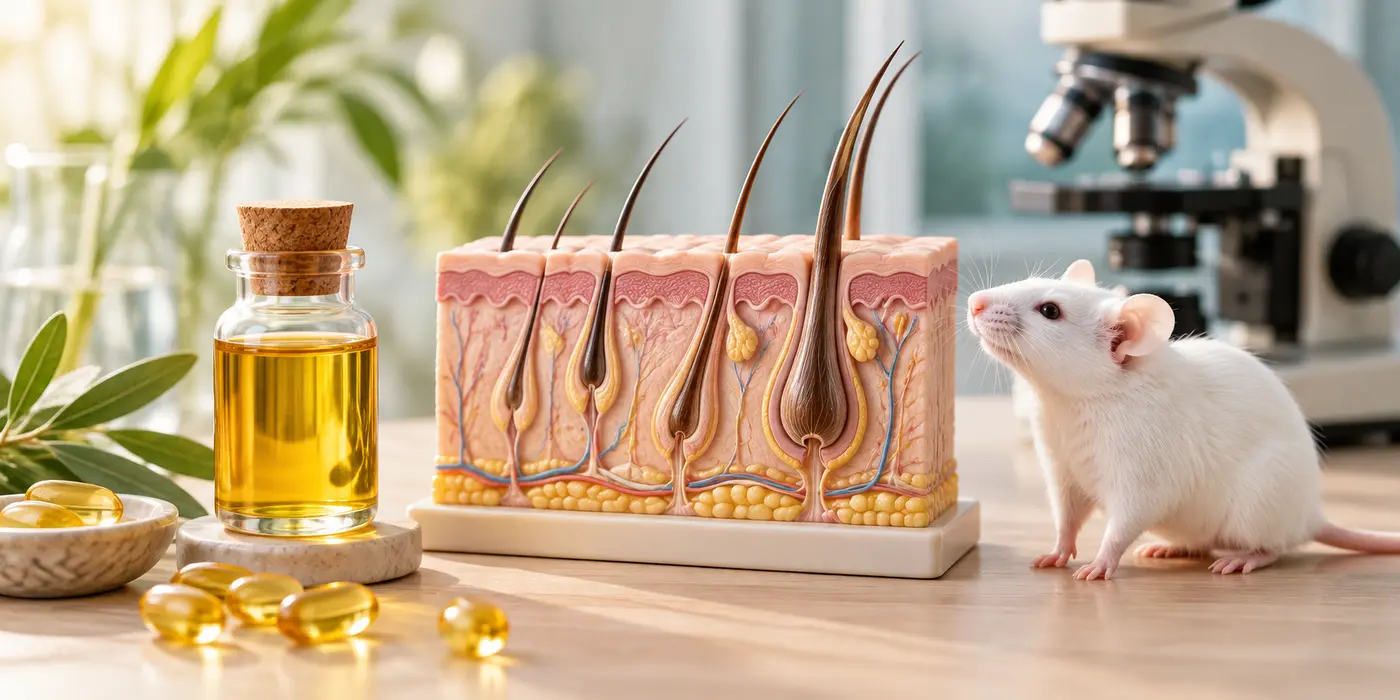
What did the 2017 mouse study actually test?
Ahmed and colleagues applied a tocotrienol-rich fraction to depilated skin of healthy and diabetic mice, with observations over 21 days. More follicles entered anagen, the active growth phase. The treatment reduced E-cadherin, a protein involved in cell adhesion, and increased β-catenin signaling. A chemical that blocked β-catenin also reduced the hair-cycle response, supporting that pathway’s involvement.
There was a trade-off: the treatment partly impaired the mice’s skin barrier. The paper also included cultured human skin cells, but no treated human scalps. It therefore identifies a mechanism to investigate—not evidence that applying vitamin E oil is an effective or harmless hair-loss treatment. Read the full 2017 study.
Did an oral tocotrienol trial find more hair in people?
A 2010 randomized, double-blind study enrolled 38 volunteers with hair loss; 35 completed eight months. The active capsules supplied 100 mg/day of mixed tocotrienols together with alpha-tocopherol, another form of vitamin E.
In a fixed 4 cm² scalp area, mean hair count increased 34.5% with supplementation versus a 0.1% decrease with placebo. The difference was significant at eight months, but not four. This was a small trial in volunteers with varying hair-loss presentations, not proof that every type responds. One author was affiliated with Hovid, the capsule supplier. Read the full human trial.
Why does the hair-weight result change the interpretation?
The investigators also weighed standardized hair clippings. That measure did not improve significantly. The positive finding was more counted hairs in the measured area, not a demonstrated increase in strand weight or thickness. Keeping both outcomes visible gives a more useful picture than reporting the 34.5% figure alone.
How closely do these studies match a product?
Oral capsules and a topical laboratory preparation are not interchangeable. Neither paper tested every commercial tocotrienol formula, and neither establishes that applying the contents of an oral capsule to the scalp will reproduce the findings.
Related reading and product information: Green-tea and resveratrol hair-growth mechanisms · Super Absorbable Tocotrienols. The shop listing is ingredient-related; it is not presented as the formulation tested in either paper.